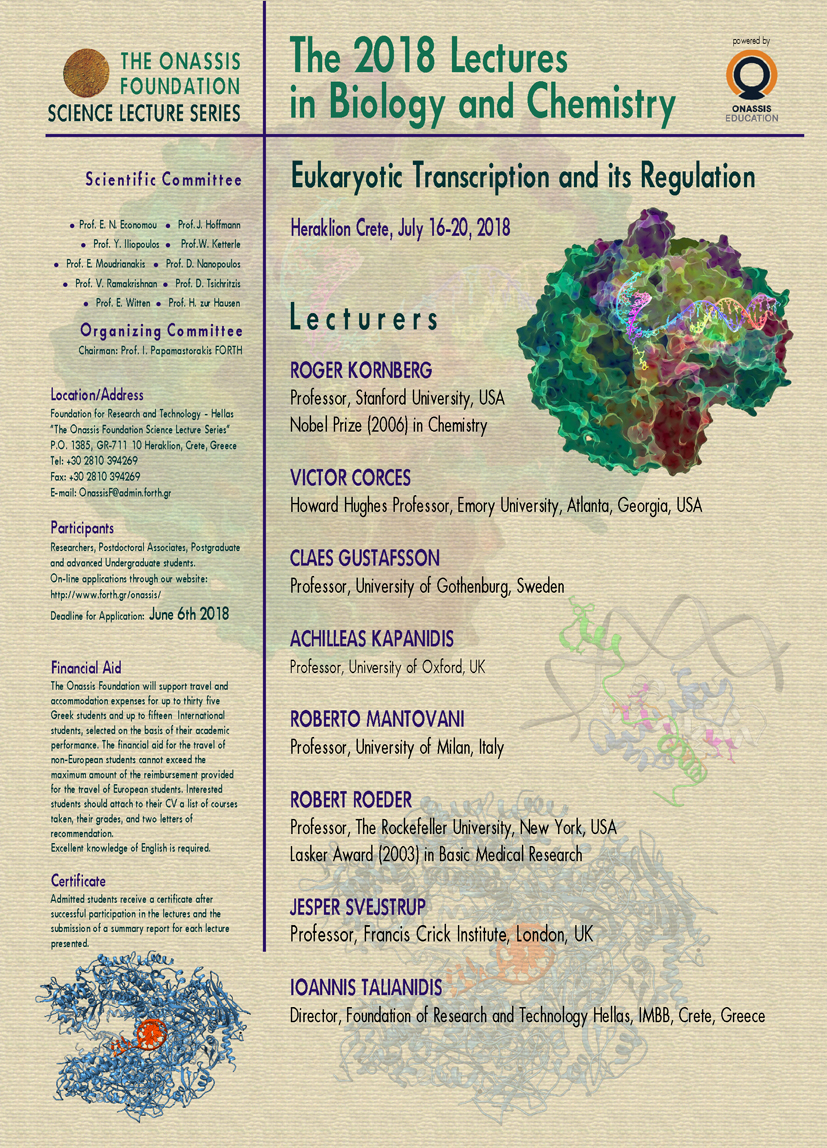
Eukaryotic Transcription and its Regulation
July 16-20, 2018
Abstract
The sequence of bases in DNA constitutes an organism's genetic code. This means that it contains within it all the information which may be called upon in the future -at the right time and place - to direct the biochemical processes that contribute to the organism's morphogenesis and to the regulation of its overall metabolism. However, this stored information, as such, represents a static state. By analogy, it resembles the notes of a music score, which come to life – and their melody is perceived – only when the score is executed by the orchestra.
Something similar happens with the information stored in DNA, which remains static until it is “activated” (transcribed) through dedicated and specific biochemical steps. The first stage in this expression is the transcription of the gene from the DNA to RNA molecules (messenger, mRNA) through the action of protein enzymes (DNA-dependent RNA polymerases). The nucleotide-sequence code in the mRNA is then translated within the ribosome into the amino acid code, that is, into sequences of amino acids (the building blocks of proteins) that yield specific protein molecules, such as a multitude of metabolic catalysts (enzymes), structural proteins, etc., but also to some regulatory, non-protein-coding RNAs.
All forms of life (with few exceptions) consist of several hundreds of different cell types each designed to perform specific tasks, which contribute to the overall functioning of the organism. The remarkable diversity in cell specification within one organism is achieved via the precisely regulated expression of a subset of the genes in each cell type.
Transcription of eukaryotic genes is a multistep process that involves the ordered assembly of large multiprotein complexes in gene regulatory regions. The main components of the transcription machinery are Transcription Factors (TFs), possessing sequence-specific DNA binding activity and serve as anchor points for the recruitment of general transcription factors (GTFs), components of the Mediator complex and RNA-polymerase-II, the enzyme complex that catalyzes mRNA synthesis. The mechanism of activation has been a focal point in the field for several years.
A significant breakthrough in our understanding came from the seminal discoveries of Roger Kornberg who was awarded the Nobel Prize in Chemistry in 2006. His studies, combining advanced biochemical and structural analyses of RNA Pol-II and associated complexes, enabled a dynamic interpretation of the different stages of the transcription process, by providing molecular understanding of promoter recognition, mechanism of initiation, the structural basis for accurate selection of an incoming nucleotide to the DNA template and the mechanism by which the newly synthesized RNA strand is separated from the DNA template.
Roger Kornberg's pioneering discoveries engendered much subsequent research in the field aimed at understanding of how transcription is regulated during the cellular differentiation processes of normal development or by external and internal signals and how this process becomes uncontrolled and leads to appearance of various diseases. Another speaker in these Lectures and a pioneer in the field of transcription is Robert Roeder who fifty years ago discovered that there exist three types of DNA-dependent RNA polymerases, each specialized to a different domain of transcription.
The individual presentations will cover critical enzymatic stages in the transcription of eukaryotic cells within the cell nucleus, in the mitochondria, on the link between transcription and the correction of 'faults' in the genome, and on examples of specialized, tissue-specific transcription regulation. New data will be presented that correlate dynamic shifts in the 3-D organization of the nuclear genome with the correct (in place and time) genetic transcription as well as with epigenetics. Recent technological developments will also be presented which enable us to investigate transcription mechanisms at the level of single molecules and with millisecond-time resolution.
Clarification: Although the substrate of the enzymatic process of transcription is chromatin, the 2018 lectures will NOT deal with issues of chromatin structure, assembly, remodelling, etc. It is hoped that these important topic, will be addressed separately at a future time.
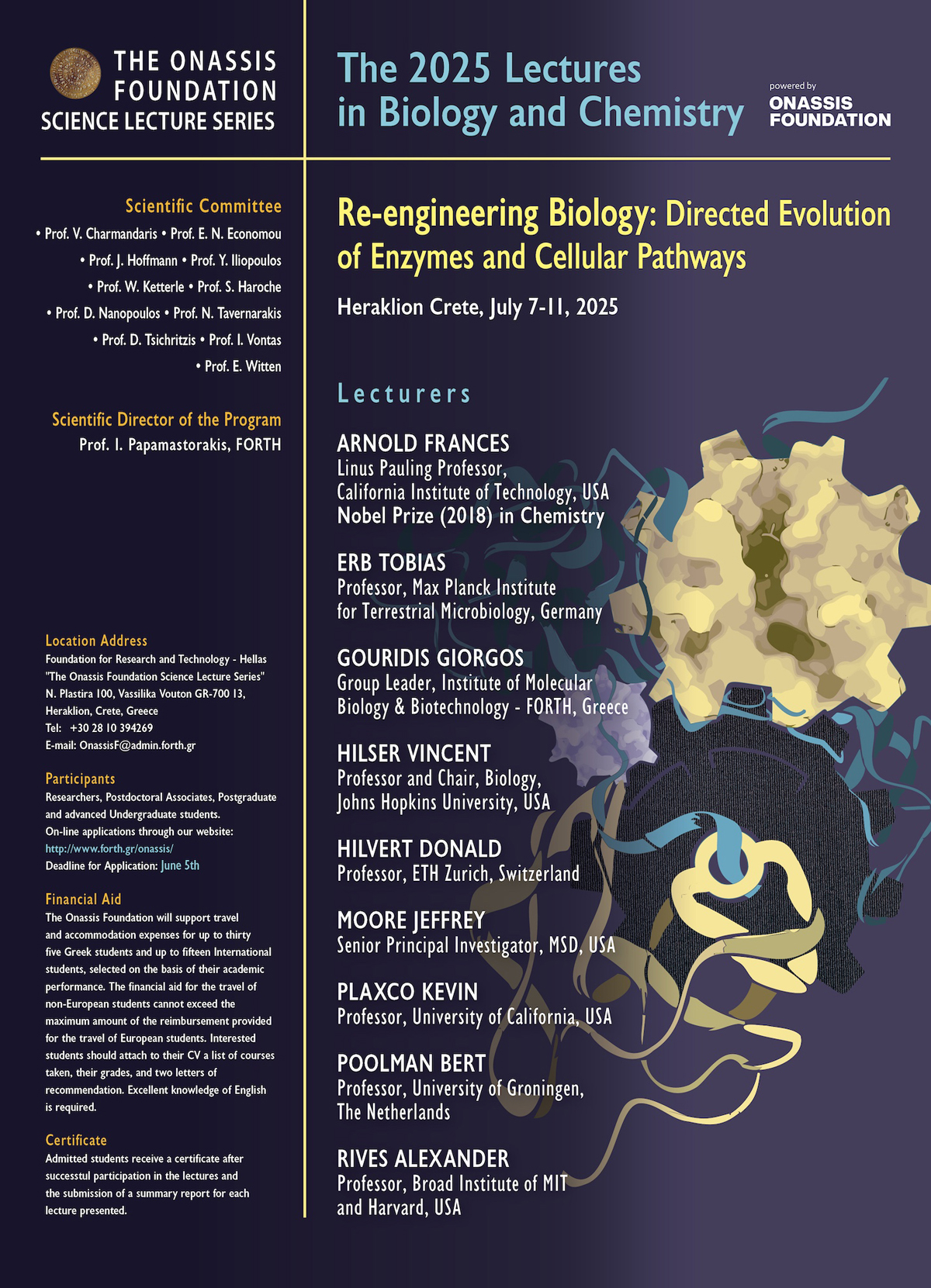
Eukaryotic Transcription and its Regulation
| MON 07 JUL |
09:00-09:45 |
Registration |
| |
09:45 - 10:00 |
Welcome |
| |
10:00 - 11:15 |
"Directed enzyme evolution: theory, practice, and future"
Prof. Frances Arnold |
| |
11:15 - 11:45 |
Break |
| |
11:45 - 13:00 |
"Fixing CO2 fixation: Re-inventing the operating system of photosynthesis"
Prof. Tobias Erb |
| |
13:00 - 14:30 |
Lunch Break |
| |
14:30 - 15:45 |
"Designing enzymes de novo"
Prof. Donald Hilvert |
| TUE 08 LUL |
09:30 - 10:45 |
"Fixing CO2 fixation: Building the hardware"
Prof. Tobias Erb |
| |
10:45 - 11:15 |
Break |
| |
11:15 - 12:30 |
"Evolving virus-like assemblies in the lab"
Prof. Donald Hilvert |
| |
12:30 - 14:0 |
Lunch Break |
| |
14:00 - 15:15 |
"Putting Enzymes to Work: Biocatalysis in Pharma"
Dr. Jeffrey Moore |
| WED 09 JUL |
09:30 - 10:45 |
"The Future of Biocatalysis (is now!)"
Dr. Jeffrey Moore |
| |
10:45 - 11:15 |
Break |
| |
11:15 - 12:30 |
"AI for Generative Protein Biology"
Dr. Alexander Rives |
| |
12:30 - 14:00 |
Lunch Break |
| |
14:00 - 15:15 |
"Accelerating Discovery with Emergent World Models"
Dr. Alexander Rives |
| |
20:00 |
"Innovation by Evolution"
Public Lecture by Prof. Frances Arnold |
| THU 10 JUL |
09:30 - 10:45 |
"The energetic basis of protein fold evolution"
Prof. Vincent Hilser |
| |
10:45 - 11:15 |
Break |
| |
11:15 - 12:30 |
"The ensemble basis of Allostery and epistasis"
Prof. Vincent Hilser |
| |
12:30 - 14:00 |
Lunch Break |
| |
14:00 - 15:15 |
"Real-time control of pharmacokinetics"
Prof. Kevin Plaxco |
| |
15:15 - 16:30 |
"Synthetic, out-of-equilibrium cell-like systems for directing reaction networks"
Prof. Bert Poolman |
| FRI 11 JUL |
09:30 - 10:45 |
"Introducing biomolecular regulation in biotechnologies"
Prof. Kevin Plaxco |
| |
10:45 - 11:15 |
Break |
| |
11:15 - 12:30 |
"Decoding Folding Landscapes with Biophysical Tools"
Dr. Giorgos Gouridis |
| |
12:30 - 14:00 |
Lunch Break |
| |
14:00 - 15:15 |
"Allosteric Evolution and Folding Landscapes"
Dr. Giorgos Gouridis |
| |
15:15 - 16:30 |
"Spatiotemporal organization of the bacterial cytoplasm "
Prof. Bert Poolman |
| |
16:30 - 16:45 |
Closing Remarks |
Eukaryotic Transcription and its Regulation